
Close





When We Grow Older is a bilingual visual and oral storytelling project exploring intergenerational care and aging, inspired by the experiences of caregivers across cultures. Original works of art by Emory Douglas, Cece Carpio, Juan Fuentes, James Quarles, Monica Ahanonu, Xia Gordon, and Yosimar Reyes are paired with personal narratives from caregivers Cesia Álvarez, María Sánchez, and María Tirado, inviting viewers to imagine a society that honors aging as a human right and celebrates the joy, wisdom, and beauty of growing older.
Through storytelling and art, the project celebrates elders whose voices deserve to be heard and honored. It also highlights the invaluable work of caregivers—both family and paid—whose labor and dedication sustain intergenerational care, often in ways that are unseen and underrecognized. The exhibition emphasizes resilience, connection, and the contributions of those who care for others across communities.
Amid ongoing threats to social safety nets and inequities in care, When We Grow Older is a call to recognize, honor, and support elders while celebrating the meaningful and joyful ways they continue to contribute to families, communities, and culture. Their stories illuminate the enduring strength, creativity, and humanity of both those who give and those who receive care.
The expanded exhibition will be shown at venues across the United States in 2026.
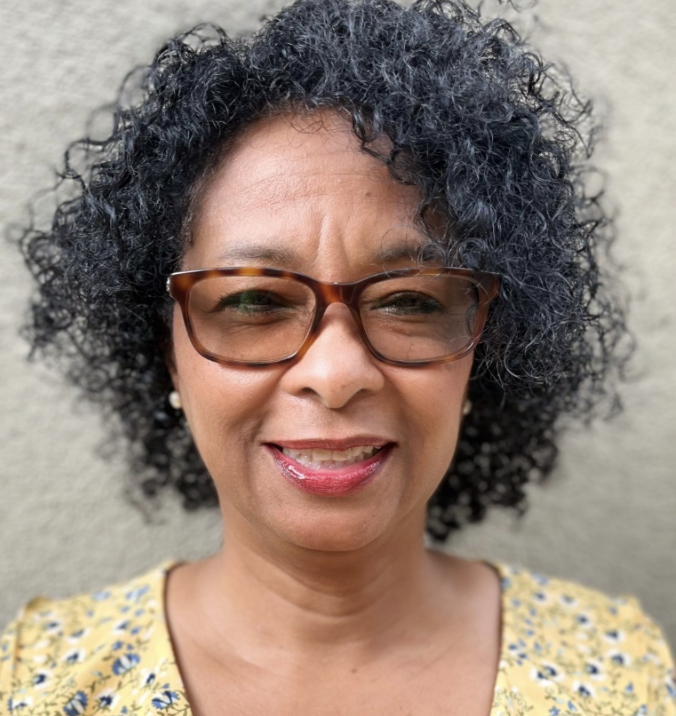
62, Los Angeles, CA
My name is Maria Tirado, I’m 62 years old, and I’m a proud African-Puerto Rican native of Los Angeles, California. I was a full-time caregiver to my parents. During this time, I witnessed the disparities and challenges in providing care, and the economic and social impacts of caregiving. I cared for both my mother and father together for over twenty five years, and my father passed in 2012. When my mother’s care needs increased, I was let go from my job due to poor performance. The fear of lost wages, possibly facing homelessness, and concern about how this would affect my mother's health and care weighed on us. However, we prevailed until my mother became an ancestor last year. Growing up watching my mother advocate for the underserved, I became an advocate for seniors amongst our Black and immigrant communities. As I did for my parents, I have also become a personal care advocate for my neighbor and have gotten her own family more involved as well. Now that I am aging, there are so many thoughts and questions. How am I going to remain self-sufficient? I’m concentrating on my health, especially if I may inherit my parents’ illnesses. Looking for employment is challenging and I’ve been experiencing ageism, but it is just an obstacle to overcome. It must be mentioned that the State program In-Home Supportive Service (IHSS) made it possible to become a full-time caregiver, but it wasn't easy. There are many improvements that are needed with the program, like increased wages, simplified hours, worker benefits and training, and protections for caregivers and recipients. We need a Caregivers Bill of Rights. Plus, corporations and businesses could implement much better policies for caregivers as well. My dream is to find a passion that’s lucrative so I can remain self-sufficient and in optimum health. I also want to continue supporting social and political causes and organizations in my mother’s honor. Now that I have the freedom, it’s time to explore the world and reinvent myself, to meet genuine people, travel to faraway lands, and enjoy exquisite cuisine while being a fashionista!
Read María's Care Story
48, San Francisco, CA
My name is Cesia Álvarez, and I’m 48 years old. I was born in Mexico and I’ve lived in San Francisco, California since 2013. As a person who’s getting older with a disability, I’m well aware that if you’re not rich, you won’t have the access to the support you need to have a dignified life. Health insurance doesn’t always cover everything you need. If you’re in a program that provides you with paid caregivers, their salary is so ridiculously low that it makes it difficult to find them. If you have a family member who can be your caregiver, that can affect the interpersonal dynamics, mental health, financial capacity, and overall relationship with you and your family. In my case, I don’t qualify to have my own paid caregiver, so I depend on people around me to have time to help me even with basic things such as buying groceries, moving furniture, cleaning the house. It’s inevitable to think back on my years full of youth, health, and energy, when I didn’t have to worry as much about money or spending, when my body was capable and didn’t hurt. I worry that in a few years everything will be even more difficult. I can't help but think about how in Mexican culture elders are loved, respected and cared for by their family and community. Even in large cities where someone might live alone, there’s usually someone who stays close to them. In the United States things are so different. There are so many barriers to caring for people as they age. As a caregiver myself, I meditate on the lessons I’ve learned from those I care for – that it’s okay to cry but to try not to allow yourself to remain stuck in hopelessness, to always look for the solutions that exist around you, and that I can find my own joy even when things are hard. My dream for the future: I would love for everyone to understand that I am happy, and to look at me as a full person instead of looking at me with pity. And I would love for our government to give more support for caregivers and people who need care, so that we can all age with choice and dignity. I’m already looking for somewhere I can live with other elders and people with disabilities, because I want to be in a place where there are people with whom I identify, and where I can make friends and be in community.
Read Cesia's Care Story
49, San Francisco, CA
My name is María Sánchez and I’m 49 years old. I was born in Mexico and I’ve lived in San Francisco for the last 28 years. I have two children – my daughter is 23 years old and my son is 21 years old. My son has cerebral palsy and I’ve been his caregiver all his life. It has been and continues to be quite a challenge for me. When I started taking care of my son I didn't know anything about how to do it, but I figured it out, and it changed my life completely. And as I get older, I worry about losing my own skills and strength. I look around and see that half of the older adults around me are aging with dignity, but the other half don’t have the same resources to afford care, and have to work until their last day just to survive. Because I’m also a caregiver, I always have to be available to my son and am always on call. My son and I depend on IHSS (in-home supports and services) for his full care needs, which helps a bit. But I still can’t work full-time or get a second job to be more financially stable and save for our futures, so I’ll probably never be able to retire. San Francisco is unjustly expensive, but if we move, we may lose access to IHSS. Plus, the cost of moving in itself is expensive. If I had more money, I would have peace of mind that my needs as I age would be taken care of, and that my kids would be taken care of, too. I worry my daughter will end up needing to spend the rest of her life taking care of me without any support, and the cycle will continue. I really want society to understand that we are all going to get older and we will need help as we get older, no matter what. My vision for the future would be that information about aging and caregiving is available from an early age. We shouldn’t be afraid of it, we should talk about it and plan for it and see it as an inevitable part of life.
Read María's Care StoryTwo videos, in color, playing on loop. The videos each feature a series of photographs of the artist, Yosimar, and his abuelita caring for one another throughout their daily lives, while Yosimar’s voice speaks poetry over the slideshows with closed captioning on screen.
Watch Video
I am a poet who is also a caregiver to my 88 year old grandmother. We are both undocumented but despite all the adversities we face in this country, I want to show the power of care and how we are each other's motivation. These two poems are a small glimpse of the many emotions I feel as a caregiver. To me, care means to be connected to something higher than me. Care is a spiritual connection, it’s empathy. These are two love poems for a woman who has taught me that no matter what happens, I carry home with me.
A colorful and vibrant illustration of the artist, James Quarles, standing beside the yellow couch upon which his mother, Ma Q, lays cozy under a white blanket with a smile and a stack of books. James, also smiling, hands her a bowl and utensils in one hand and a steaming mug in the other. They’re in a living room decorated with owl print wallpaper, a large houseplant and a lamp which lights up the space, casting a shadow of James against the orange rug covering the mahogany stained hardwood floor. Ma Q has a medium brown skin town, voluminous white afro and white rimmed glasses to match. James has a lighter brown skin tone, wearing a green jacket and green pants with a burgundy top, hat, and shoes to match. In the background, against the owl-print wallpaper, hangs a large blue patterned frame displaying James’ original poem, “Divine Feminine” written in black ink.
View Artwork
This piece, both the illustration and the poem, is a representation of how I care for those who have always cared for me, using the gifts handed down to me by cherished family members. The poem is in reference to finding the strength possessed by the women caregivers in my family tree, how I honor them, and hold them in such high regard. Who will take care of the caregivers? "WE WILL!"
A colorful and vibrant illustration with a Cherokee style pattern in deep sea blue-green with different size triangles in gradients of tan, pink, and olive green in the background. The original poem “Always Open” by artist James Quarles is written in white ink against this pattern. In the foreground sits Ma Ellen, the Black Cherokee 104 year old great grandmother of the artist. She has short white and black hair, a soft smile, and a dark brown skin tone. She’s wearing a light blue dress, white pearl earrings, a gold necklace and large shades. Ma Ellen has one arm wrapped around the toddler boy sitting in her lap with an excited expression on his face. There is another little boy standing upright and resting his head against the boy in Ma Ellen’s lap. He has a soft smile and gentle look on his face. Standing beside these three is an adolescent girl with two pigtails, a pearly white smile and a medium brown skin tone of the same shade as her little brothers. These children are the younger cousins of James.
View Artwork
This piece is dedicated to my Greatgrandma "Ma Ellen" who raised 10 kids on a farm in North Carolina, and always made sure everyone was taken care of until her death at the age of 104. She was a strong, kind hearted, Black, and Cherokee woman. And although at times it seemed like there wasn't enough room for joy, love, or celebration in this world, she would always show you how to make it.
A colorful and vibrant painting depicting four generations of medium brown skin-toned women and girls caring for each other. A baby (4th generation) in a white gown sits in the lap of her great grandmother (1st generation) who is in a wheelchair wearing a floral printed dress. The great grandmother’s daughter (2nd generation), wearing a white tee shirt, sits behind her combing her hair. Behind her stands her own daughter—the baby’s mother—(3rd generation) braiding her mother’s hair into cornrows. This scene is set on a beach with cascading ocean waves, yellow sand, and tall beachgrass. The blue and white of the sky and ocean water is juxtaposed by a red circle painted at the center of the scene behind the women.
View Artwork
This piece is inspired by María Tirado, Cesia Álvarez, and María Sánchez whose stories are featured in this exhibit, and the shared vision of care for elders being filled with ease, love, and dignity, within and as part of the cycles of nature. It also embodies part of my own story in which my mother was abroad taking care of other families while I grew up and being cared for by my great-grandmother who raised four generations of our family. The ritual of hair braiding is an intimate act, a weaving element of passing down traditions of wisdom and care.
A colorful and vibrant illustration, depicting a woman wearing an elegant green and blue dress and multicolor headwrap sitting at a sewing table with multicolored fabric draped over it, between her adult daughter dressed in a fuschia dress with blue stripes and purple headwrap, and her granddaughter wearing a simple blue dress and long ponytail. All three women share a similar deep brown skin tone. They smile, as the grandmother teaches her eager granddaughter how to sew, and her own daughter stands behind her fastening the bow on the back of her dress.
View Artwork
A young granddaughter, learning to sew and mix patterns just like her grandma. Meanwhile, her mom is fixing her grandma's clothes, showing how we all help and care for each other over time. Patience, grace and willingness to see the positive, is what care means to me.
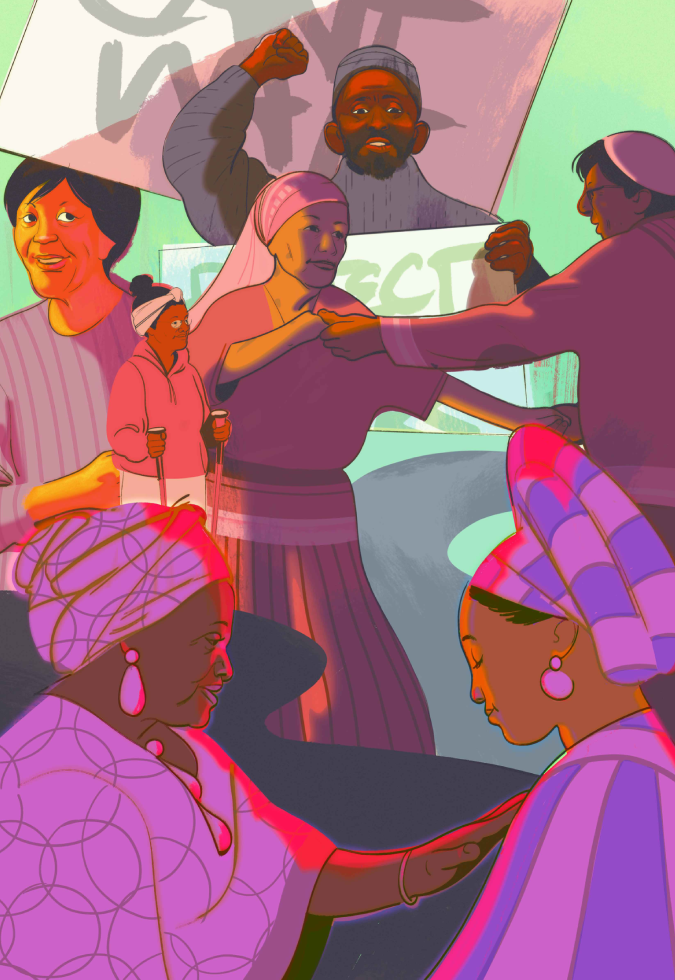
Illustrated as a collage of four vignettes, elders are depicted with vibrant livelihoods. An elder couple dances to the beat of their own music while holding hands. The man wearing long sleeves and a Kippah and the woman in a skirt, tee shirt, and a headscarf. Beside them, an older woman in a jumpsuit strolls through nature with her walking sticks. An activist with deep brown skin wearing a gray tunic and matching Taqiyah strives for political change, with his right fist in the air and his left hand holding a ‘Respect Elders' sign. By his side is a woman with medium tone olive skin wearing a purple striped shirt holding a ‘Care Can’t Wait’ sign. In the foreground, an older woman with darker brown skin places a hand on the collar of a faithful young woman with medium tone brown skin, offering wisdom and comfort. Both women are wearing headwraps, draping earrings, and soft gazes. Everyone is painted on a winding gray-black road against a light green background.
View Artwork
This piece captures the elegant and timeless essence of elders gracefully navigating the
currents of life, each step a testament to their accumulated wisdom and inner strength. It’s a
tribute to the enduring beauty and wisdom that elders bring to the world, their existence echoing the profound depth of their experiences. Caring, to me, is akin to tending a garden. It's about nurturing the growth or well-being of those around me, providing a safe space for them to flourish, and expressing that through meaningful gestures and steadfast support.
A gathering of Indigenous, Chicano/Latino, and African American figures stands rooted together, their bodies close, their presence steady and enduring. The words "Migration is a Human Right" arch across the top of the illustration. Elders, adults, and children share the frame, each face etched with memory, labor, and survival. Monarch butterflies move through the scene like quiet messengers of migration and return, while doves hover as symbols of peace and collective care. From the earth below, roots rise and entwine, holding the figures together and feeding new life above them. Flecks of green leaves and warm orange wings break through the muted tones, signaling growth, resilience, and renewal. The words "Giving Roots, Nurturing Generations" anchor the piece as a tribute to working families and caregivers across time — to those who migrated, who stayed, who struggled, and who continue to sustain one another through care, dignity, and love.
View Artwork
Migration is dedicated to working families, to the many grandmothers, mothers, and daughters who help raise kids. The print is a tribute to working men of color, to the diversity in our American families, to those thousands who dared to migrate and continue to struggle and survive. A tribute to our Indigenous, Chicano/Latino, African American cultures.
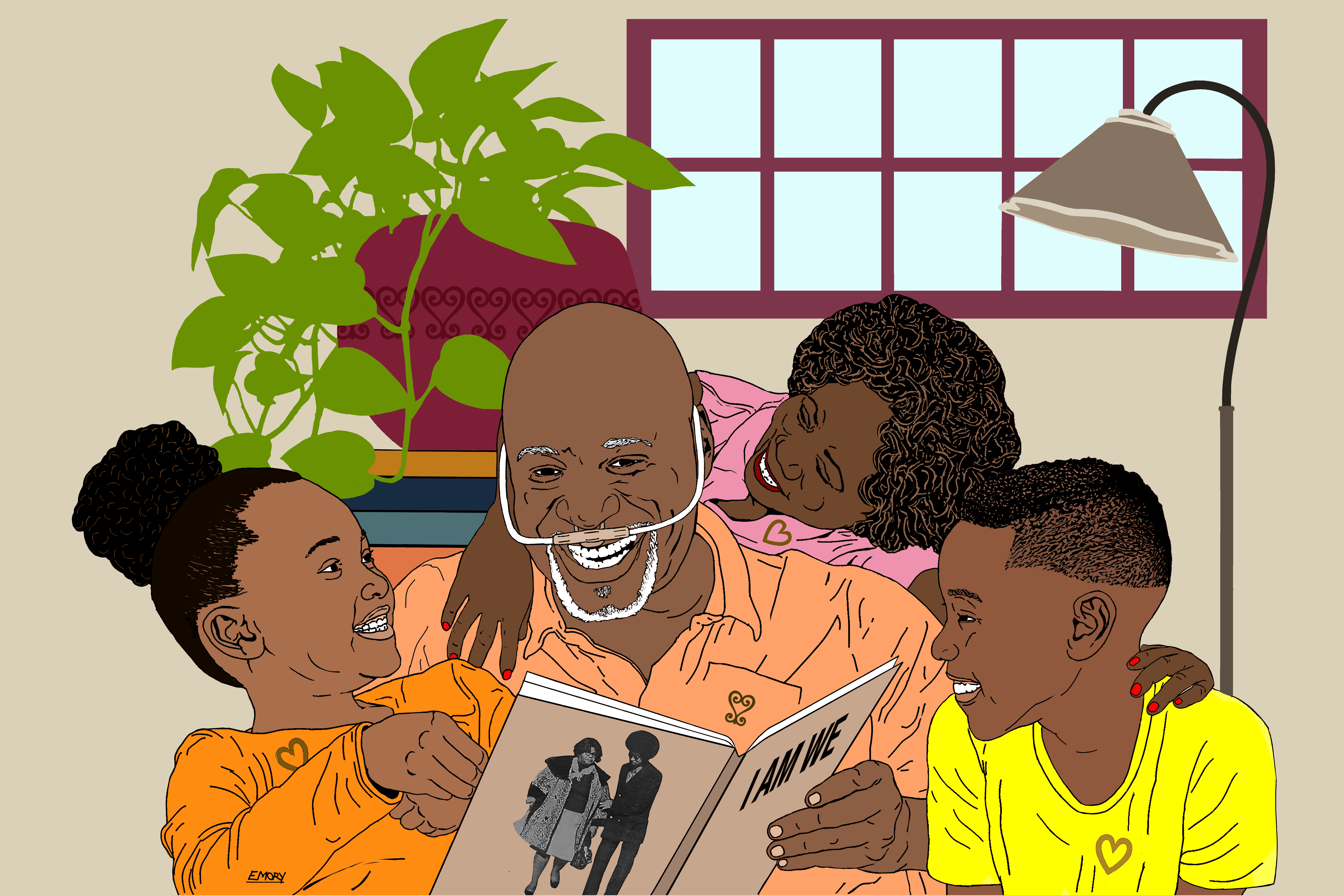
A warm, intimate illustration by Emory Douglas shows an African American elder, presumably the grandfather, seated at home wearing a breathing support tube, reading a book titled I AM WE to his two young grandchildren — a girl with her hair in a bun on one side and a boy with a fresh, tight haircut on the other. His wife, with soft curls, stands behind him, wrapping her arms around him in a loving embrace. The scene unfolds in a calm, lived-in space, with a plant, a window, and a softly glowing lamp in the background. Rendered in earth tones, the image exudes comfort and joy, honoring aging as a shared, loving experience grounded in family and belonging.
View Artwork
Emory Douglas’s art has always asked who is protected, who is valued, and who is left behind.
I AM WE brings those questions into the realm of aging and care, framing care as an act of solidarity and collective responsibility. The work insists that how we treat elders reflects the kind of society we choose to be.
I AM WE © 2026 Emory Douglas / Licensed by AFNYLAW.COM
Stay tuned for upcoming installations of When We Grow Older